
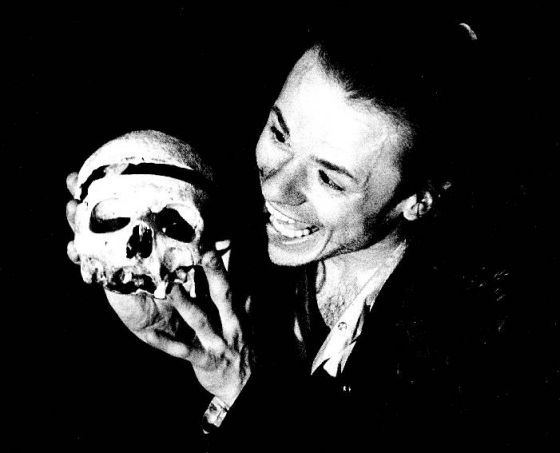
This article first appeared in the programme for George Dillon’s production of Hamlet in 1995.
Contents
- Interpretation
- Quotes on Hamlet
- Stage History
- Story, Dates, Sources, Texts, Cuts
- Hamlet’s creator, William Shakespeare?
Interpretation
A player’s Hamlet
On hearing of the arrival of the players, Hamlet does not ask the natural question “What players are they?” until after he has prescribed their roles and corresponding fates: “He that plays the king shall be welcome – his majesty shall have tribute of me; etc.” The six roles he describes and the fates they suffer match the other main characters in Hamlet, and so arose the idea of a touring company of six stock-character actors, directed by Hamlet, performing the outer as well as the inner play, in a manner reflecting the practices of the world’s two oldest surviving theatrical forms, Commedia and Noh.
Man of Action
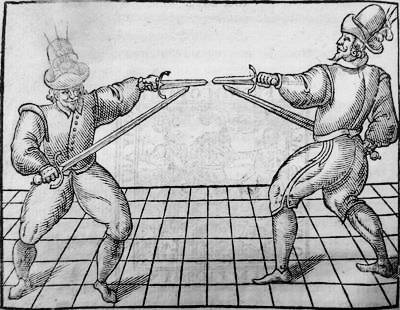
I try to avoid forming any directorial concept before rehearsals, but after ten years of wanting to play Hamlet and after seeing many ill-conceived productions (the only performance I have admired unreservedly has been that of Mark Rylance), it was inevitable that I should have formulated some idea of what the play and the character are about. Towards the end of the play, Hamlet says he has “been in continual practise” at swordsmanship, and the King bets on him defeating Laertes in nine out of twelve passes. Knowing that the role demanded some skill with a sword, and lacking any fencing training myself but with a little experience of Chinese martial arts and a fascination with Japanese culture, I began Kendo training on 6th May 1991, not knowing that it would influence my entire outlook on Hamlet, acting and life in general. When I did eventually come to play Hamlet, I found in him no trace of the conventional intellectual prevaricator, and further study of the development of action within the play, its stage history, and Elizabethan thinking on royalty, ghosts, revenge, madness, and readiness for death confirmed my feeling that Hamlet is a classical Man of Action.
The events of the play are, in true classical fashion, highly condensed, with one incident rapidly following upon another in a near continuous stream of action. Each of the three movements of the play covers a period of no more than 48 hours. Hamlet’s self-reproach in the soliloquies and in the closet scene, far from being the self-disgust of a prevaricator actually springs from the frustration of a man who can and does kill in an instant in both hot and cold blood. By contrast, Laertes’s willingness to cut Hamlet’s throat in the church, which academics have often admiringly contrasted with Hamlet’s supposed inaction, reveals only cowardice.
With the example of Charles Windsor before them and a stage history of two centuries of romantic misrepresentation, critics and audiences may expect to see royally stiff-backed, pompously-spoken, neurotic Hamlets laboriously weighing up the pros and cons of getting up off their backsides to actually do something. Personally I find nothing so tiresome as watching actors putting on airs to play aristocracy and while the 60s idea of Hamlet as working-class hero may not be strictly correct, to the Elizabethans it would have proved more royally than Hamlet the Ponce.
The ghost
Elizabethans held three views on ghosts: Catholics believed they were spirits released from purgatory for a purpose; Protestants held that they were devils; and sceptics thought them the illusions of melancholy minds. The Ghost in Hamlet has something of each doctrine, so neither the Prince nor the audience can be sure of his story. The veracity of the Ghost has great significance for the question of whether Hamlet delays; whether he is a hero or a coward. To be an avenger and not just an assassin, Hamlet must confirm the Ghost’s story before killing the King, and realising this he instantly forms a plan to go ‘undercover’. Although two months pass between his first interview with the Ghost and the play-within-the-play (when he gets the corroboration he needs), and another two months pass before he returns from England and kills Claudius, despite his own misgivings and self-accusation these delays are entirely due to factors outside Hamlet’s character or control.
Hamlet’s madness
A more truly ambiguous question is the reality or not of Hamlet’s lunacy. In Act One Hamlet declares his intention to “put an antic disposition on“, but later, in his treatment of Ophelia and the killing of Polonius, he appears to be genuinely, tormentedly mad, so that when he tells his mother that he is “not in madness, but mad in craft”, neither she nor the audience can believe him. The question is not answerable from the text, but it is one which every actor of the role must consider. Just as in the martial ways, physical discipline also trains the mind and spirit, so, like Plato, I believe that by the repetition of roles actors come to resemble the characters they play. This applies both to Hamlet and to the actor playing him. Richard III is famous for giving actors bad backs, and Hamlet is renowned for driving actors mad; one recent British Oscar winner had to quit a National Theatre production after (reportedly) seeing the ghost of his dead father in a lift!
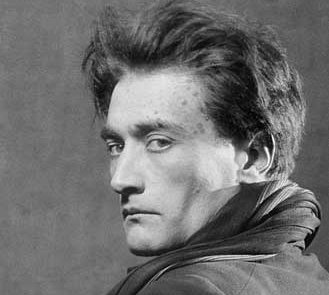
Both Hamlet and Ophelia lose their self-control and this ultimately causes their own deaths, and so by the definition of madness as a self-defeating loss of reason, both may be considered truly mad. But there is a more modern notion of madness which that cracked actor, Antonin Artaud, summarised:
“And what is an authentic madman? It is a man who has preferred to go mad, in the sense in which society understands the term, rather than be false to a certain superior idea of human honour … a madman is also a man to whom society did not want to listen and whom it wanted to prevent from uttering unbearable truths.”
Hamlet’s death
For me, Hamlet is, above all, a play about coming to terms with death. At the beginning Hamlet cannot accept the death of his father. By the end he has accepted his own – “The readiness is all.” Playing the final act, I was constantly reminded of The Hagakure’s advice:-
“I discovered that the Way of the Samurai is death. In a fifty-fifty life or death crisis, simply settle it by choosing immediate death. Just brace yourself and proceed … In order to be a perfect samurai, it is necessary to prepare oneself for death morning and evening day in and day out. When a samurai is constantly prepared for death, he has mastered the Way of the Samurai, and he may unerringly devote his life to the service of his lord.”
Yamamoto Tsunetomo, The Hagakure
The background to Hamlet’s philosophy is, of course, Christian but several Christian commentaries contain attitudes similar to the Hagakure. Martin Luther said that Christians “should behave as those who are at every moment ready for death“, Calvin that “we ought to live as if we were every moment about to depart this life” and St. Francis Bales in Letters to Persons in the World wrote: “Happy are they who, being always on their guard against death, are always ready to go“. Christ himself preached:
“Watch therefore, for ye know not what hour your Lord will come… Therefore be ye also ready, for in such an hour as ye think not the Son of Man cometh.” (Mathew 24:42 & 44).
Perhaps, as we approach the end of the millennium, this coming to terms with impending doom explains the current popularity of the play.
Back to contents
Quotes on Hamlet
‘If some man haue committed murder, hee that will combate with him, must not doe it to this ende, onely to wreake the death of him that is murdered, in respect that he was his freend or kinsman, but he ought to call to minde what a noble and excellent creature man is, who being taken away and brought to naught by murder or slaughter, the fairest and noblest worke which almightie God hath framed, is marred, and spoiled…. And for that God in his sacred law hath ordeined, that manslayers should be carryed from his alter and put to death, the partie that will combate…. ought not to undertake the combate because he would kill him, but because hee might be as it were, the minister to execute Gods … most holy commaundement.’
Vincentio Saviolo, Practise, 1595
‘What should we account of death to be resembled to anything better than sleep… Most assured it is that such sleeps be most sweet as be most sound, for those are best wherein like unto dead men we dream nothing… there is nothing that doth better or more truly prophesy the end of life, than when a man dreameth that he doth travel and wander into far countries… and that he traveleth in countries unknown without hope of return… We are assured not only to sleep, but also to die… only a cowardly and corrupt conscience do cause thine unhappiness.’
Cardan, De Consolatione, translated in 1573.
‘To be, or not to be, I there’s the point, To Die, to sleepe, is that all? I all: No, to sleepe to dreame, I mary there it goes, For in that dreame of death, when wee awake, And borne before an everlasting judge, From whence no passenger euer retur’nd, The vndiscouered country, at whose sight The happy smile, and the accursed damn’d.’
First Quarto, 1603.
‘To the man of action, life frequently appears as a circle to be completed by the addition of one last point. In contrast, the life of an artist or philosopher appears as an accumulation of gradually widening concentric circles around himself. But when death finally arrives, who will have the greater sense of fulfilment, the man of action, or the artist? I should think that a death which in an instant completes one’s world by the addition of a single point would afford a more intense feeling of fulfilment by far. The greatest calamity for the man of action is that he fail to die even after that last unmistakable point has been added.’
Mishima, On Hagakure, 1967.
‘The Dionysian man resembles Hamlet; both have once looked truly into the essence of things, they have gained knowledge and knowledge inhibits action; for their action could not change anything in the eternal nature of things; they feel it to be ridiculous or humiliating that they should be asked to set right a world that is out of joint. Knowledge kills action; action requires the veils of illusion: that is the doctrine of Hamlet, not that cheap wisdom of jack the Dreamer who reflects too much, and, as it were, from excess of possibilities, does not get around to action. Not reflection no – true knowledge, an insight into the horrible truth, outweighs any motive for action.’
Friedrich Nietzsche, 1872.
‘… the most successful Hamlet of my day was Barry Sullivan, an actor of superb physical vigour, who excelled in the impersonation of proud, noble and violent characters, All the sentimental Hamlets have been bores.’
George Bernard Shaw, 1918.
‘…a miserable and mighty Poet of the human Heart. The middle age of Shakespeare was all clouded over; his days were not more happy than Hamlet’s who is perhaps more like Shakespeare himself in his common every day Life that any other of his Characters… Hamlet’s heart was full of such Misery as mine is when he said to Ophelia ‘go to a Nunnery, go, go!‘ Indeed I should like to give up the matter at once – I should like to die, I am sickened at the brute world which you are smiling with. I hate men and women more.’
John Keats, 1819.
‘I had always felt an aversion from Hamlet: a creeping, unclean thing he seems, on stage…. his nasty poking and sniffing at his mother, his setting traps for the king, his conceited perversion with Ophelia make him always intolerable. The character is repulsive in its conception, based on a self-dislike and a spirit of disintegration.’
D H Lawrence, Twilight in Italy, 1913.
‘May one not consider the tragedy of Hamlet as a play in which the tears are glimpsed through a series of traditional theatrical pranks? Should we not forget once and for all the arguments of scholars about the strength or weakness of Hamlet’s will, ignore all the various intentions which are attributed willy-nilly to the author? The same may be said of Shakespeare’s age as of the theatre which preceded him: ‘The whole gamut of artistic expression was played on two notes – the merry and the sad; moreover, the sad was frequently intermingled with the horrific and the merry with the caricatured; the intermediate notes expressing the more refined emotions were of little significance. Of music, singing, plays, etc. the public demanded that it be either deeply moved or made to laugh until it cried; if one and the same song or play achieved both ends, so much the better.’
Vsevolod Meyerhold, 1915.
‘Situation is the mechanism that grabs the attention of the audience and keeps them on the edge of their seats. Blasetti used a more colourful expression when he said; ‘It is the nail sticking out of the stool which keeps the spectator’s bottom in the right place.’ In Hamlet there are at least fifteen situations, one after the other… it continues in a satanic crescendo: corpses, sudden shifts in direction and the situation right up to the final slaughter, which represents the point of conciliation of all the coordinates and of all the twists and turns of the situations. From these the closing catharsis is released, It is a proof of the sheer genius of the complex of situations which is Hamlet that I once sat through a performance of this tragedy given by a bunch of the worst kind of hams, and yet I realised that I was still gripped by the story. Even though I knew the script by heart, the situations held me and were more than enough to overcome the vexation of that amateurism.’
Dario Fo, Tricks of the Trade, 1989.
‘For our decade, I think the play will be about the disillusionment which produces an apathy of the will so deep that commitment to politics, to religion or to life is impossible; there is a sense of what-the-hell anyway, over us looms the Mushroom Cloud.’
Peter Hall, Programme Note, 1963.
‘Hamlet is the posturing, self-pitying egotistical baby-cum-adolescent in us all, and the play is the prototype of western literature’s most deplorable and most formless form, autobiographical fiction.’
Brigid Brophy, 1968.
Back to contents
Stage history
Sir Laurence Olivier described, in On Acting, how the role of Hamlet has passed from actor to actor since Richard Burbage played the first Hamlet and then coached the second, Joseph Taylor. After the reopening of the theatres in 1660, William D’Avenant, who had seen Taylor’s performance, directed Thomas Betterton. David Garrick studied and learned from some of the older members of Betterton’s company, and Edmund Kean from the survivors of Garrick’s and so on by direct tuition or through observation via Henry Irving, Olivier and Steven Berkoff to George Dillon!
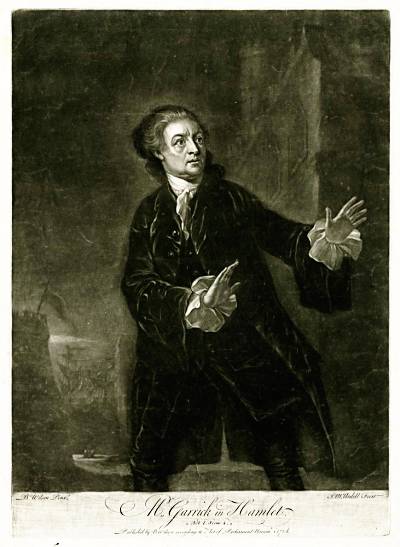
Just as our knowledge of Shakespeare’s life is conjectural so too is our impression of the way Burbage played the first Hamlet, but from seventeenth century allusions to the play in performance and from Betterton’s prompt-books, whose cuts are thought to reflect Elizabethan practise, we know that Hamlet was originally seen as a crazed avenger, energetically and often comically mad but with no question about his decisiveness or bravery. The restoration was, however, a more delicate age, and David Garrick, who played the role from 1742 to 1776, cut all the impieties and indecencies and began the refined misconception of Hamlet’s character which ruled for the next two hundred years: ‘Whether in the simulation of madness, in the sinkings of despair, in the familiarity of friendship, in the whirlwind of passion, or in the meltings of tenderness, he never once forgot he was a prince; and in every variety of situation, and transition of feeling, you discovered the highest polish of fine breeding and courtly manners‘ wrote the playwright Hannah More of Garrick in 1774.
In 1783 the twenty-six-year-old John Philip Kemble chose Hamlet for his London debut as a direct challenge to the leading actor of the day, John Henderson, and was praised by many as being his equal. When Henderson died of food poisoning in 1785 the way was clear for Kemble to shine alone for the next thirty years. After Garrick’s ‘naturalism’, Kemble’s acting swung the aesthetic pendulum back towards stylisation ‘It was a great effort of a great artist, but I could never discover aught in it save the rehearsal of an endeavour‘ wrote one spectator. Tall and handsome – Kemble bore a striking resemblance to Eric Cantona! – although his style was flamboyant, his characterisation was, however, entirely orthodox, pleasing the conservatism of the age.
‘He fixed on melancholy as the essence of the character and sought to give a generalised and idealised portrait of that single trait. Sadness hung like a visible colour over everything he said and did. Levity, anger, tenderness, intellectual pleasure – all were subordinated, suppressed, subsumed.‘
John A Mills, The Great Tradition
At 5 feet 4 inches, Edmund Kean was altogether the opposite of Kemble in appearance, and in his acting too he represented a return to the naturalism of Garrick. Garrick’s widow, at the age of eighty, attended his every performance at Drury Lane and hailed Kean as Garrick’s rightful heir. Even his direct predecessor’s niece, Fanny Kemble, was an admirer, praising his reading as ‘exquisitely touching and melodious in its tenderness, and in the harsh dissonance of vehement passion, terribly true.’ However, Kean was inconsistent in the role, causing Samuel Coleridge to comment that watching him was ‘like reading Shakespeare by flashes of lightning‘.
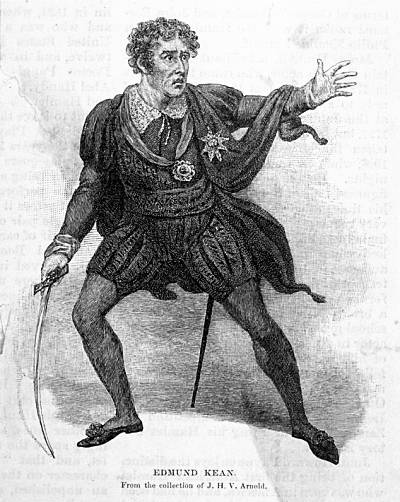
In the late nineteenth century, the dramatic potential of Shakespeare’s original texts was rediscovered and the production ethos centred on a charismatic star actor was toppled by William Poel who used only amateurs, Edward Gordon Craig who subordinated actors to set design and Harley Granville Barker who promoted the totalitarian rule of the director. Poel devoted 50 years to the attempt to stage Shakespeare ‘exactly as it was given the first time it was acted‘ in Elizabethan costume, without sets, with musical accompaniment on original instruments. He used the shorter and more dynamic First Quarto of Hamlet as the text for his first historic production in 1881. He also started the tedious trend of staging Shakespeare uncut; the first ‘complete text’ production of Hamlet (a combination of everything from the three different texts) was produced by Francis Benson at the Lyceum in 1901.
The Age of Science also introduced a more psycho-analytical approach to acting. In the early nineteenth century Hamlet had been dreamily poetic, and the acting involved declamatory delivery, statuesque poses, sweeping gestures and long pauses. Towards the end of the century and in the early 1900s there was a reaction against this artificiality. The soliloquies, for example, were now played as ‘spoken thoughts’ with Forbes-Robertson and even Henry Irving making no eye-contact with the audience. The 1920s and 1930s saw the ultimate triumph of psychological acting, in the emotional prince of Gielgud and Olivier, the Oedipal son.
In the immediate post-war period, the choice was still limited to the honourable or the Freudian prince, but in the 1960s everything changed. Olivier chose to direct Peter O’Toole in Hamlet as the first production of the National Theatre at the Old Vic in 1963 and hinted in the programme that Hamlet resembled John Osborne’s archetypal angry young man, Jimmy Porter. Richard Burton, who had created Jimmy Porter in the film of Look Back in Anger, played Hamlet in 1964 directed by John Gielgud, and his tough, virile Hamlet (albeit with an upper-class accent) attracted world attention, and broke box office records on Broadway. The angry young man proper finally arrived with Peter Hall’s 1965 production in which David Warner, at 24 the youngest Stratford Hamlet, spoke his soliloquies direct to the audience. ‘As for Glenda Jackson as Ophelia, one can only yammer in admiration. This was a regular man-eater: a highly sexed young woman, cracking under the strain of a disintegrating love affair.’ (Hugh Leonard).
From the mid-sixites to the late-seventies experimentation was in. Frances de la Tour joined the ranks of the female Hamlets, and Jonathan Pryce writhed and growled as he doubled as the ghost of his own father (which saved hiring another actor!) In 1976 Peter Hall again directed Hamlet as the last production of the National Theatre at the Old Vic, with the 39year-old Albert Finney playing a burly, athletic, Lancashire-accented, unprincely, modern, hard-bitten young man, racing through his poetic speeches sporting a Samurai headband.
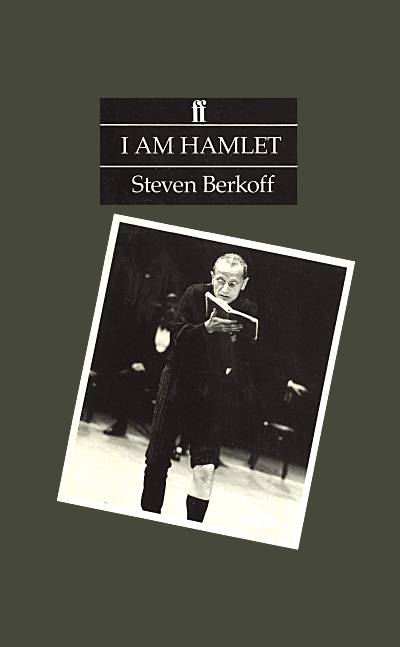
In 1979, while Derek Jacobi was scoring a hit at the Old Vic, Steven Berkoff sold his mother’s premium bonds to finance his Edinburgh production in which he directed himself. It is said that when the Guardian’s theatre critic, Nicholas de Jongh, wrote that he was ‘fatally miscast’ and the actor later chanced upon him in a restaurant and half-jokingly threatened to kill him, the credulous critic’s editor call in police protection. Berkoff later wrote in his production journal I am Hamlet:
‘Since Hamlet touches the complete alphabet of human experience every actor feels he is born to play it. The bold extrovert will dazzle and play with the word power… The introvert will see every line pointed at him, the outsider, the loner, the watcher, he… The wit will play for laughs and the lunatic for madness. The romantic for ideals. So you cannot be miscast for Hamlet ‘fatally miscast’ as one critic called me in fact since he too had his version of Hamlet fixed in his head.’
Steven Berkoff, I am Hamlet, 1989, Faber & Faber
Back to contents
The story
The King of Denmark, Old Hamlet, has recently died and his brother, Claudius, has married his widow, Gertrude, and been elected King. Prince Hamlet is visited by the ghost of his father who describes how he was secretly murdered by Claudius and swears him to remember and revenge.
To escape suspicion, Hamlet feigns madness, which the elder statesman, Polonius, believes to be caused by love for his daughter, Ophelia, whom the Prince had previously courted but now cruelly discards.
Hamlet’s chance to verify the Ghost’s story comes when a group of players arrives at court and he has them play a scene similar to his father’s murder before his uncle, who stops the play and hurries out, deeply disturbed. Summoned to his mother’s chamber to be scolded, Hamlet hears someone spying on them and instantly draws his sword and stabs through the curtain, killing Polonius. Hamlet is arrested and agrees to be sent to England, not knowing that his companions carry his death warrant.
While Hamlet is away, Ophelia goes mad and her brother Laertes, who has returned demanding revenge for his father’s death, is shocked first by her madness and then by her death, reportedly by drowning. When letters arrive from Hamlet announcing his return, Claudius persuades Laertes to kill Hamlet in an arranged fencing match using a sharp, envenomed foil while Claudius prepares a poisoned goblet, as a fallback.
Hamlet returns during Ophelia’s funeral and after wrestling with Laertes in her grave, accepts the challenge. The king’s plot back-fires when Hamlet, though fatally wounded, turns the poisoned sword on Laertes, and, after his mother dies in agony from drinking the poisoned cup, he kills Claudius. Finally Hamlet also dies.
Dates
Stratfordian scholars generally agree on late 1599 as the date for Shakespeare’s initial composition of Hamlet and 1601 for its completion, although a play of the same name, which academics distinguish as the Ur-Hamlet (and attribute to Thomas Kyd on the basis of a single piece of flimsy evidence), is known to have existed as early as 1589. A version of Hamlet was certainly performed in June 1594 and in 1596 Thomas Lodge described the “ghost which cried so much at The Theatre, like an oyster-wife, Hamlet, revenge.” The Oxfordian scholar, Charlton Ogburn, argues that the real writer wrote his first version in 1586, and revised it periodically until he died in 1604, whereupon “the true and perfect Coppie“, the Second Quarto, was published, “enlarged to almost as much againe as it was” from the pirated bad First Quarto of the previous year.
Sources
While the earliest reference to the legend of Hamlet occurs in an eleventh century Icelandic poem, the earliest written version of the story appears in Saxo Grammaticus’s twelfth century Historiae Danicae, and tells of Amleth (derived from the Old Norse word for idiot), Prince of Jutland. When his uncle Feng murders his father and marries his mother, Amleth escapes death himself by pretending to be a harmless fool, and after similar adventures to our Hamlet (plus marrying the King of England’s daughter), he kills Feng, burns his palace with all of the court inside, is elected ruler of Jutland and lives to die in battle a few years later. Francois de Belleforest retells the story in his Histoires tragiques of 1570, and it is on this account that the play is based, although the Stratfordians curiously attribute the structural diversions from the Belleforest version to the more creative unknown writer of the Ur-Hamlet, reducing their Shake-speare to a mere hack word-smith.
Texts
The first ‘bad’ Quarto of the Tragical Historie of Hamlet Prince of Denmarke by William Shake-speare was published in 1603 and is generally thought to be a pirated ‘reported’ text, as remembered by a journeyman actor who had played Marcellus and Lucianus in Shakespeare’s company. The Second Quarto was hastily published the following year and while it has some 3,800 lines compared to the First Quarto’s 2,200 it also abounds with errors. The First Folio was printed in 1623, and contains 70 lines not in the Second Quarto and cuts 230 lines from it. Hibbard’s view is “that the Second Quarto represents Shakespeare’s first draft of his play; that the Folio text is essentially his revision to that first draft, together with some additions to it; and that the First Quarto is a reported version of an abridgement of this revised text.” That the Folio probably represents Shakespeare’s own revisions to his first draft suggests that it was prepared either from the prompt-book at The Globe or from a fair-copy made by the author himself, and of the three versions it is certainly the most actor-friendly.
Cuts
‘I have seen the worst. The very worst. The most worst. The utmost, boring, uncut versions – as if there was something virtuous and nourishing about an uncut Hamlet. All it does is to reveal the imbecility of the director and cast and makes for a bad evening, since the uncutting implies a wholly ingratiating attitude which will impede any real insights (i.e. challenge, life, light, imagination) into the play.‘
Steven Berkoff, I am Hamlet, 1989, Faber & Faber
In cutting the text, my objective was to produce a coherent version, performable, at speed, by seven actors within two hours, while preserving as much of the original speech and narrative as possible.
Although I have studied nearly two dozen stage and screen productions, I have followed no single authority other than my own sense of what works and the preface to the 5th Quarto:- ‘The play being too long to be conveniently Acted, such places as might be least prejudicial to the Plot or Sense, are left out upon the Stage.’ I allow that the result of my cutting has been to condense the flow of the narrative and that this has reinforced my interpretation of Hamlet as a ‘Man of Action’, but in this approach to the role I claim many famous precedents including Thomas Betterton and through him Richard Burbage, the first Hamlet. With one notable exception I have avoided reordering the text and I have made only one deliberate interpolation, substituting a more modern oath for Hamlet’s retort to Polonius ‘God’s bodykins!‘ Generally I have favoured the variants of the Folio (in The Oxford Shakespeare text, edited by G R Hibbard, 1987) above the two Quartos, except where the latter are significantly closer to present-day usage and so more intelligible to today’s audiences. Similarly, I have not insisted upon Elizabethan stress patterns or pronunciations where to do so would have caused unnecessary problems to a modern ear.
Otherwise I have tried, both in the editing of the text and in its delivery, to preserve the integrity of the metre and meaning of the original.
Back to contents
Hamlet’s creator, William Shakespeare?
Shaksper with an ‘a’
It is astonishing but it is a fact that we know nothing for certain about the life of the man who wrote Hamlet. All the evidence which directly connects the plays to the Stratford business man, William Shaksper, has been shown to have been forged. All the well-known stories about the playwright’s life have been invented by his various biographers, wilfully confusing the little we know of the life of the Stratford man with the career of the playwright and embellishing the result with their own inventions.
The surname was not uncommon in Elizabethan England, the first written record of it tells of a William Saksper being hanged for robbery in 1248. After the christening on 26 April 1564 of ‘Gulielmus filius Johannes Shakspere‘, the Stratford man next appears as ‘Willelmus Shaxpere‘ and ‘William Shagspere‘ on two documents relating to his marriage in 1582. Clearly this man’s name was pronounced with a hard ‘a‘.
Shakespeare’s signature
The only authenticated examples of his hand-writing are the six scratchy signatures on legal documents, each spelt differently. (Charlton Ogburn comments in The Mystery of William Shakespeare: “How could anybody have thought that a man who could barely sign his name was the greatest writer in the English language?“) During the Stratford man’s lifetime the name Shakespeare only appeared on two long poems in 1593, some unofficial editions of individual plays, and The Sonnets. None of these is spelt the same way as any of the Stratford man’s signatures.
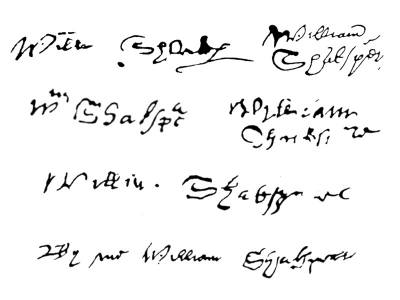
The one and only time that the writer used the name himself was in signing the dedication of the poem Venus and Adonis, where he also describes the work as ‘the first heir of my invention‘. Hastivibrans, or ‘the Spearshaker’, was the soubriquet of Pallas Athena, patron goddess of the home of the theatre, so it would be a natural choice as a pseudonym for an educated poet-playwright but an amazing coincidence if one were actually born with the name. That the name ‘Shakespeare‘ was known at the time to be an invention is supported by the frequency with which it appeared hyphenated, as it did on the title page to the First Quarto of Hamlet in 1603. Before the collected First Folio of 1623, thirty-two editions of single plays were published with the writer’s name on the title page. It was hyphenated fifteen times. Not once was the Stratford man’s name hyphenated.
Shakespeare’s death
When The Sonnets were published in 1609 the dedication referred to ‘our ever-living poet’ suggesting that the real author was already physically dead. When the Stratford Shaksper died in 1616 there was no public mourning, no poetic tributes, no-one seemed to have noticed or cared. His will, which leaves his wife his second best bed, contains no reference to his supposed play-writing career, nor his most valuable possessions; the manuscripts to his unpublished plays and his shares in The Globe and The Blackfriars theatres. References to his supposed theatrical business partners, Burbage and Condell, have been proved to be later additions in another hand.
Not only the writer’s identity, but also the very existence of many of Shakespeare’s works was kept secret during his life-ime. Of the thirty-six plays collected in the 1623 First Folio, twenty were previously unpublished and three Timon of Athens, Coriolanus, and All’s Well That Ends Well had never been heard of before.
Shakespeare’s image
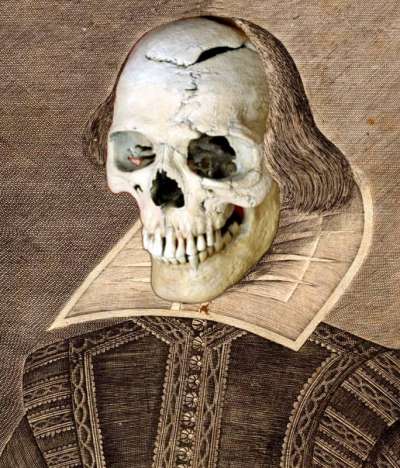
The familiar portrait of Shakespeare, Droeshout’s engraved image in the First Folio, on which all other portraits are based, raises more questions. How, at the age of twenty-two, could an artist produce the portrait of a man who retired to a small market town when the artist was seven, died when he was fifteen and whom he had almost certainly never met? Why does the portrait have two right eyes? Why is the right hand side of the front of his tunic actually the back of the left hand side? And what is that hard line running from below his left ear to his chin? Ogburn suggests it is a picture of a man in a mask.
The man who wrote Hamlet
Sigmund Freud, who studied Hamlet when formulating his concept of the Oedipus complex, commented in his speech accepting the Goethe prize in 1930:
‘It is undeniably painful to all of us that even now we do not know who was the author of the Comedies, Tragedies and Sonnets of Shakespeare; whether it was in fact the untutored son of the provincial citizen of Stratford, who attained a modest position as an actor in London, or whether it was, rather, the nobly-born and highly cultivated, passionately wayward, to some extent declasse aristocrat Edward de Vere….‘
Hamlet has often been called Shakespeare’s most autobiographical play. While the Prince’s story bears no resemblance to the life of William Shaksper of Stratford, there are a number of striking and illuminating similarities to the adventures of Edward de Vere, the 17th Earl of Oxford, who was born in 1550 and died of the plague on 24th June 1604. His father taught him hunting, riding and falconry. When he was eleven he watched as Queen Elizabeth was entertained by his father’s group of players in the great hall of their stately home. A year later his father died, his mother remarried a man named Tyrrell (the name given to the murderer of the babes in the tower in Richard III) and Edward was adopted by Lord Burleigh, Elizabeth’s chief minister and the most powerful man in England. Burleigh’s diary shows the young de Vere to have had a passionate temperament, as well as a keen intelligence. At the age of 17 he killed a cook in self-defence and later, after he graduated from both Oxford and Cambridge, he married Burleigh’s daughter and became a favourite of the Queen. After travelling in Europe and particularly in Italy, he returned to find his wife unfaithful but when he himself had an illicit affair he was imprisoned in the Tower of London. Oxfordians believe that Burleigh and Elizabeth, to conceal the family’s shame, made it a condition of de Vere’s release from prison that he should hide his authorship of the plays behind the pseudonym he had used five years earlier, William Shake-speare.
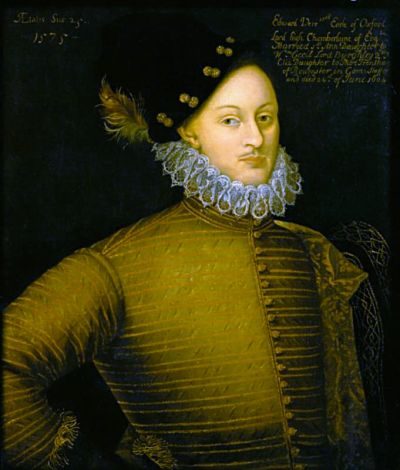
It is widely accepted that the model for Polonius’s ‘few precepts’ of advice to his son was Burleigh’s Precepts for his son Robert Cecil. Hamlet’s rejection of Ophelia parallels de Vere’s cruelty to his wife, Anne, and as for Hamlet’s parents, Freud’s An Outline of Psychoanalysis explains: ‘Edward de Vere… lost a beloved and admired father while he was still a boy and completely repudiated his mother who contracted a new marriage very soon after her husband’s death.’
If the author of Hamlet was indeed the aristocrat, Edward de Vere, then having hidden his true identity, Hamlet’s dying words with their fear that the truth would never be known are agonisingly appropriate:
‘0, God, Horatio, what a wounded name, things standing thus unknown, I leave behind me! If thou didst ever hold me in thy heart, Absent thee from felicity awhile, And in this harsh world draw thy breath in pain, To tell my story.‘